
A Post-War Unexpected Island of Democracy
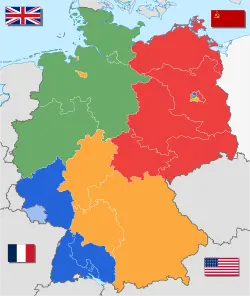
I recently finished the last episode of World War II with Tom Hanks, the new documentary that premiered on the History Channel this summer. It was so good! Even in the last episode, I learned something I never knew before about World War II.
When the war ended, the Allies divided Germany and Berlin into four occupation zones. The United States, Great Britain, France, and the Soviet Union each controlled an area. Eventually, East Germany and East Berlin became communist under the Soviet Union, and West Germany and West Berlin became democratic under the United States, Great Britain, and France. That much I knew, but the documentary showed me just how cut off West Berlin was from the rest of West Germany. It was a tiny and unexpected island of democracy in the middle of a large communist area. In fact, it was 110 miles from West Germany!
The Soviet Union used its isolated location to its advantage. In 1948, Joseph Stalin ordered the Berlin Blockade, cutting off all overland supply routes to West Berlin. The blockade failed as Allied planes regularly flew in food and provisions. Stalin gave in and lifted the blockade after eleven months.
Through the Marshall Plan, the United States gave more than $1 billion in aid to West Germany and West Berlin. As a result, the economy in West Berlin was thriving, and many people who lived in East Berlin commuted each day to the western side of the city to work. The East German leader, Walter Ulbricht, was not happy about this and petitioned his superiors regularly to do something about it.
In 1961, Nikita Khrushchev, the then leader of the Soviet Union, finally agreed, and in a surprise move, the Berlin Wall was built overnight. Sadly, the wall remained until 1989, separating loved ones and resulting in at least 140 people being killed while trying to escape. Fortunately, more than 5,000 did successfully escape. I got to see a piece of the Berlin Wall in Orlando, Florida!

From the Nazi regime to bombs to reconstruction and then division, the people of Berlin faced many hardships during and after World War II. To learn more about Berlin after the war, read the History Channel’s fascinating article at https://www.history.com/articles/berlin-wall-construction.
“From all she writes about Berlin’s bombed-out buildings and rebuilding, I think she’ll find it pleasant,” Carson answered and met her gaze this time.
The Final Song, Chapter 15


Comments